|
Artemy Lebedev
§ 119. To hell with yoSeptember 6, 2005 |
|
The Russian Ё (ё) [yo] is an inchoate letter. It’s the letter е [ye] with a diaeresis (umlaut, trema, two dots above) that’s acoustically comparable to the German ö and the French eu. Although at the beginning of this century there were upwards of 10,000 words and word forms with ё in Russian, using it everywhere is an act of brutality against the reader. |
|
The diacritic (superscript) mark above е plays a double role: helps resolve ambiguity (осел/осёл—settled down or donkey) and for accentuation (ё is always stressed). The distinction between other homographs in the Russian language is made by just putting accent marks over them (зáмок/замóк—castle or lock). There are also some words whose meaning, if out of context, is unclear (лук/лук—bulb onion or bow (a weapon)), which does not count as a legitimate reason to make some graphic additions to them. |
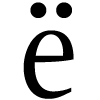 Cyrillic letters may appear funny, but this one really looks like Mickey Mouse |
|
Obiter dictum |
The letter ё was first brought into use by princess Dashkova at a meeting of the Russian Academy of Sciences in 1783. She must have been eyeing the label on a Moët & Chandon bottle prior to that.  In the name of this champagne the dots were placed above the letter E in order to spare the reader the temptation to read OE as a single sound Œ (i.e. “myo” instead of the right “moe”). |
|
The proponents of the ubiquitous use of the letter ё sometimes cross the line of decency in trying to make their case: |
|
Pchelov E., Chumakov V. Introduction // Two centuries of the Russian letter YO. History and Dictionary. Moscow: Narodnoe Obrazovanie, 2000 |
|
Yo, and before 1917 the seventh consecrated position of the 35-letter alphabet was impiously usurped by the letter Ж. |
|
Let us try and overcome the reverend awe. Is it so hard indeed for us to forgo ё? |
|
In Russian we speak and write Richelye (instead of Richelieu), Freid (whereas he was straight Freud) and Rentgen (who in actual fact was Röntgen), and do so without a bit of scruples. At the same time, we say Goethe, but write Gethe. |
|
|
Any Russian text can be transliterated in Latin, with the letter ё usually rendered as “e”. For example, Sting sings in his pre-perestroika song “Russians”, “Mr. Krushchev said we will bury you // I don’t subscribe to this point of view”. The surname of the General Secretary of the Communist Party contains the letter ё, but no one transliterates his name as “Krushchyov”, even in Russia. |
Nikita Krushchev was named TIME Man of the Year in 1957 Sting. Russians // The Dream Of The Blue Turtles. 1985 |
|
Housekeeping tip |
We can use an example from foreign practice. The English word “cooperation” should in fact be spelt “coöperation”, as double “o” is pronounced as [u:]. The same rule is applicable to the words coördination, reëlection, reëntry, reëxamination and the like. Since everybody knows that the word “cooperation” is pronounced as co-operation, not coo-peration, the diacritic mark above the second vowel is only put there by the most devoted nit-pickers (The New Yorker and The Economist, the website artlebedev.com are among the few who do). |
|
Grownups are pretty good at reading and know how to pronounce words. Accents and the letter ё are only printed in preschoolers’ books to help children acquire reading skills. A grownup would normally stumble while reading these simplified texts. |
 |
|
Rule. Ё should be used: if various readings are possible; in dictionaries; in books for people learning Russian (i.e. children and foreigners); to make sure rare toponyms, names and surnames are read correctly. In all other cases the letter ё does nothing but hamper reading. It looks bad, but sounds nice. |
The slogan of Yandex, the Russian search engine (“You’ll find it all”), does contain two ё’s. While coining it we reasoned that inasmuch as even the ill-fated letter is present in the slogan, it will testify to the engine’s extraordinary search performance |
 |
|
|
|