Zhurnalus — 10 years
Ten years ago, “Zhurnalus” appeared, publishing everything most important, interesting and useful from the world of design — so that designers don’t have to spend valuable time searching for professional information.
Today not only has the volume of information grown — the industry itself has also grown and radically changed. The boundaries between specialties have blurred: designers write code and texts, marketers create finished advertising materials, and developers do design. “Zhurnalus” has gone through this path together with the market. Now it is a media outlet for everyone who creates digital products: designers, developers, entrepreneurs, managers and marketers.
Kirill Oleynichenko launches the first “Design Digest” — a newsletter that includes 20–30 carefully selected materials. Later it will be precisely from it that “Zhurnalus” will grow. Even then the main principle of the project is formed: only content that has practical value.


The newsletter gains hundreds of regular readers, and the editorial office gets its first employee — Natalya Telyatinskaya. Artemy Lebedev becomes a subscriber of the service, and the studio arranges a corporate subscription, becoming the first major client. The first special issue is released, dedicated to 60s design.
The mailing list “for our own” turns into a product for the entire industry. Issues acquire sections, “Zhurnalus” appears in a Telegram bot. For the first time, authors appear who write materials specifically for the newsletter.
I love and respect this project madly and constantly recommend it to everyone. I don’t skip a single newsletter.
Most of all I like the “Inspiration” section. On your own it takes a long time and laziness to go around different sources, look at what someone has done, and do this on a regular basis. And in the newsletter all the selections come at once, like on a platter.
In my courses on typography and graphic design, and also whenever I am asked for advice on where to look for inspiration, I first of all recommend Odi’s newsletter. I haven’t come across anything better yet.

Today’s information flow mercilessly drowns the reader. Every day a multitude of materials about design are published by media outlets and by countless bloggers.
My respect to the editorial team: from all this flow the guys select the most important things. I especially like the digest release format — before the weekend. During the week the brain is busy with work tasks, and on Friday evening it is just convenient to plan for the weekend the study of the main news about design, reviews of new tools and interesting articles and ideas that I share with my team and eagerly study myself.

The format is close to me in how it works with experts: respectfully, thoughtfully and without attempts to simplify complex thoughts. The editorial office is not afraid of ambiguous points of view and encourages the author’s voice — a rarity for industry media.
Each publication here for me is not just an article or a comment, but a part of a professional conversation about where design and advertising are actually heading.

I am almost not subscribed to design channels, because usually there is a pile of scattered content that accumulates in the archive and is never read.
And here once a week they send a big selection of good materials in one place. You grab a coffee, flip through for an hour, learn all the news of the week, save the useful stuff and then get back to work.

This is a must‑have thing for any designer, of any level and denomination. I remember how I always waited for a new issue to come out to replenish the collection with something interesting. And just reading the news from the world of design was always useful.
I’m glad that the team has preserved the approach to presenting information and has significantly diversified the content. Need materials about interfaces or typography — they are there. Interested in illustration, packaging or three‑dimensional graphics — that’s there too, plus humor and the “Random” section have been added, where it’s nice to take your mind off things.
I want to wholeheartedly thank everyone who works on creating the content. This is an incredible, colossal and very important job for the entire design industry.

I have 72 design channels on Telegram in my subscriptions. Here are the peppy guys, here the cheerful ones, here the productive ones. Sometimes you do catch a fish in the pond, but rarely. You have to filter a lot. The abundance of information leads to its inevitable inflation. There is too much trash.
I also have a channel in which at this moment there are 44,901 unread messages. I now just keep this channel as an artifact.
And here there are almost no throwaway materials. The authors take the trouble to write not for the sake of letter count, but to formulate meaning. This is a lot of work. I went in in the morning: out of 10 articles read, 2 were useful right away, 1 I set aside for later. This is a concentrate.

I love and respect this project madly and constantly recommend it to everyone. I don’t skip a single newsletter.
Most of all I like the “Inspiration” section. On your own it takes a long time and laziness to go around different sources, look at what someone has done, and do this on a regular basis. And in the newsletter all the selections come at once, like on a platter.
In my courses on typography and graphic design, and also whenever I am asked for advice on where to look for inspiration, I first of all recommend Odi’s newsletter. I haven’t come across anything better yet.
Today’s information flow mercilessly drowns the reader. Every day a multitude of materials about design are published by media outlets and by countless bloggers.
My respect to the editorial team: from all this flow the guys select the most important things. I especially like the digest release format — before the weekend. During the week the brain is busy with work tasks, and on Friday evening it is just convenient to plan for the weekend the study of the main news about design, reviews of new tools and interesting articles and ideas that I share with my team and eagerly study myself.
The format is close to me in how it works with experts: respectfully, thoughtfully and without attempts to simplify complex thoughts. The editorial office is not afraid of ambiguous points of view and encourages the author’s voice — a rarity for industry media.
Each publication here for me is not just an article or a comment, but a part of a professional conversation about where design and advertising are actually heading.
I am almost not subscribed to design channels, because usually there is a pile of scattered content that accumulates in the archive and is never read.
And here once a week they send a big selection of good materials in one place. You grab a coffee, flip through for an hour, learn all the news of the week, save the useful stuff and then get back to work.
This is a must‑have thing for any designer, of any level and denomination. I remember how I always waited for a new issue to come out to replenish the collection with something interesting. And just reading the news from the world of design was always useful.
I’m glad that the team has preserved the approach to presenting information and has significantly diversified the content. Need materials about interfaces or typography — they are there. Interested in illustration, packaging or three‑dimensional graphics — that’s there too, plus humor and the “Random” section have been added, where it’s nice to take your mind off things.
I want to wholeheartedly thank everyone who works on creating the content. This is an incredible, colossal and very important job for the entire design industry.
I have 72 design channels on Telegram in my subscriptions. Here are the peppy guys, here the cheerful ones, here the productive ones. Sometimes you do catch a fish in the pond, but rarely. You have to filter a lot. The abundance of information leads to its inevitable inflation. There is too much trash.
I also have a channel in which at this moment there are 44,901 unread messages. I now just keep this channel as an artifact.
And here there are almost no throwaway materials. The authors take the trouble to write not for the sake of letter count, but to formulate meaning. This is a lot of work. I went in in the morning: out of 10 articles read, 2 were useful right away, 1 I set aside for later. This is a concentrate.
A third member of the team joins the editorial office — Alexander Shvetsov. “Zhurnalus” begins to conduct mini‑interviews with eminent figures from the industry.


The name changes to “Odigest”. The newsletter becomes a full‑fledged design media outlet. Annual special issues about the year’s trends begin to be released.
Students of the Gorbunov Bureau School of Designers, Evgeny Vlasov and Vladimir Yankovsky, together with the Bureau’s art director Mikhail Nozik, develop the first web version for “Odigest”.

The Artemy Lebedev Studio becomes the project’s publisher. In December “Zhurnalus 1.0” is launched — a full‑fledged media outlet with its own website.
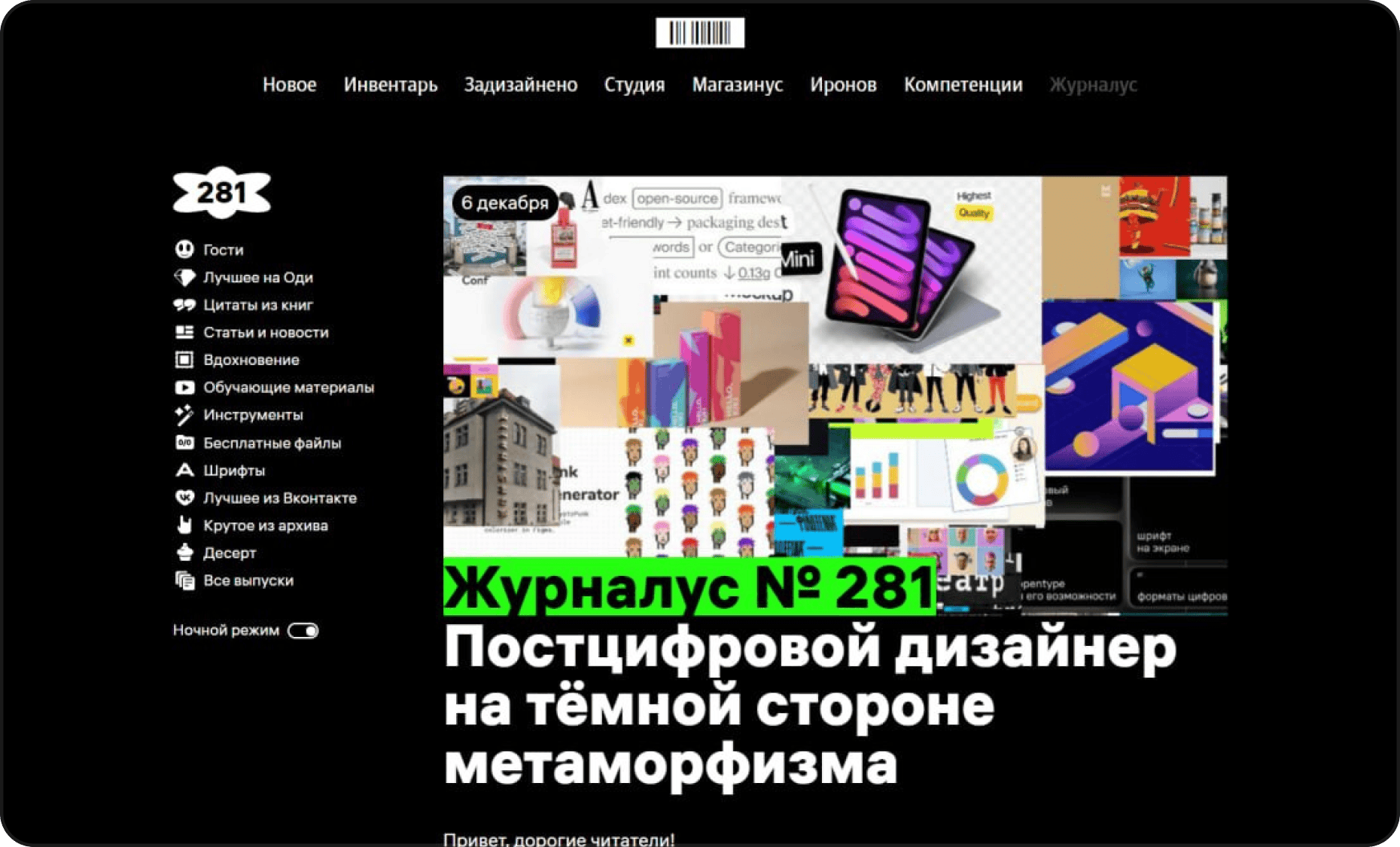
The audience of “Zhurnalus” already numbers thousands of subscribers, and the editorial office is growing. The first special issues appear, dedicated to mastering professions.






Corporate subscriptions appear, and employees of many companies, including big tech, become readers. Weekly digests help develop visual literacy and shape design culture in the largest Russian companies.

Launch of “Zhurnalus 2.0”. Telegram channels, a community, personal reader profiles, collections and an endless feed appear.
The “Neuro” section is launched. Neural networks stop being just hype — this is a technology that is changing the world and creative professions. This section helps readers adapt to the ongoing technological revolution.
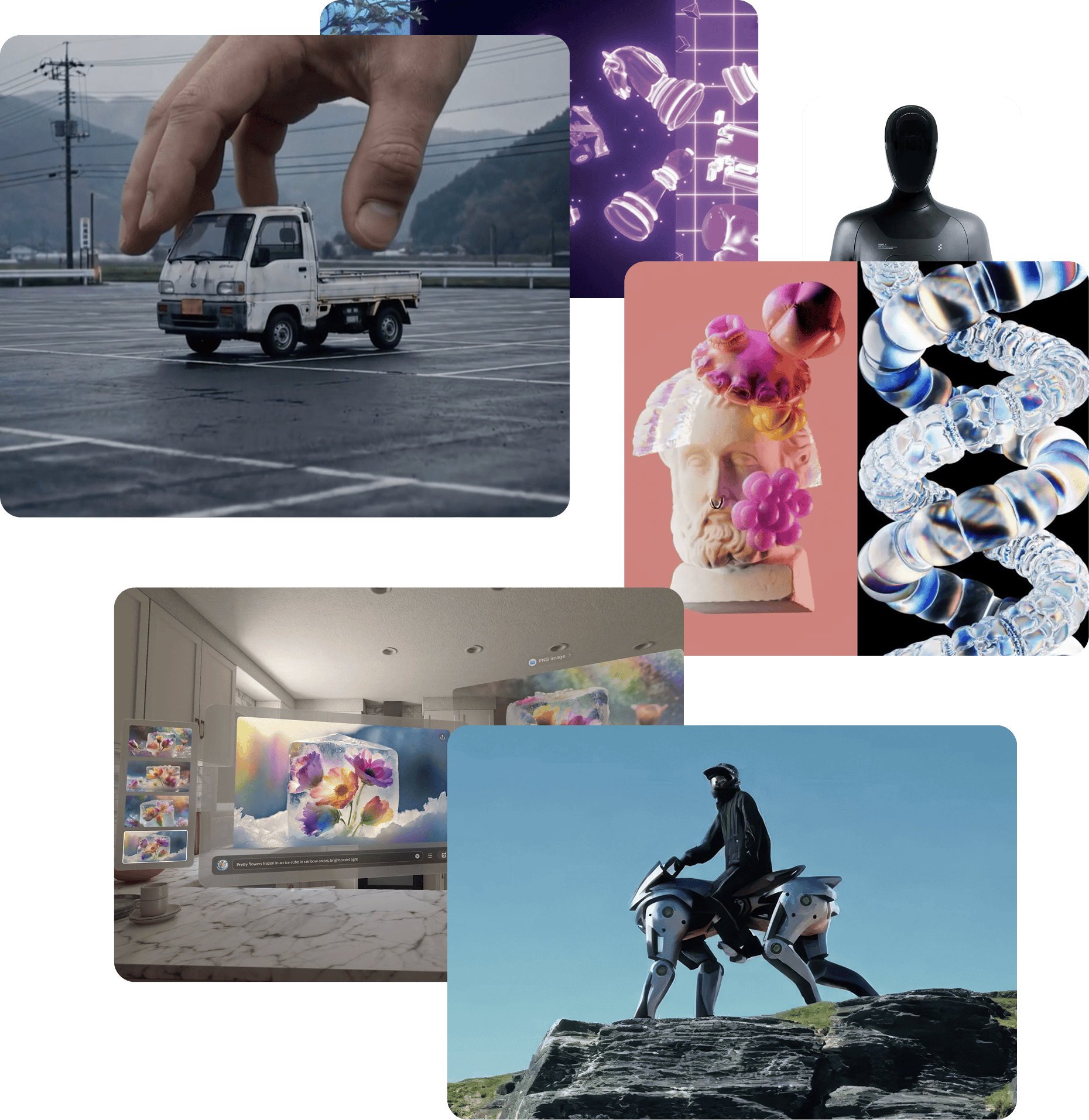
“Zhurnalus” becomes a media outlet for the entire digital industry.
Over 10 years, 66 people have taken part in the creation and development of “Zhurnalus”:
- Артемий Лебедев
- Александр Ирбис
- Александр Мрясов
- Александр Носиков
- Александр Штанг
- Алексей Ижемцев
- Алексей Хапов
- Альбина Гайнуллина
- Анастасия Байбулатова
- Анастасия Жернова
- Андрей Маслов
- Анна Крылова
- Антон Астафьев
- Арсений Трофимов
- Артем Галоян
- Анатолий Кондратцев
- Азамат Бактыбаев
- Богдан Фетисов
- Булат Мавлютов
- Владислав Шатов
- Глеб Абмайкин
- Глеб Томилов
- Григорий Мыльников
- Далер Алиёров
- Даниил Мусихин
- Дарья Барковская
- Дарья Дейнека
- Денис Гаврилов
- Дмитрий Муратов
- Екатерина Кожара
- Егор Борков
- Евгений Власов
- Евгения Могила
- Елизавета Фадеева
- Иван Демидов
- Илья Пуртов
- Кирилл Васильев
- Кристина Думанова
- Ксения Зайнашева
- Кыдана Игнатьева
- Магомедрасул Штибеков
- Майдари Эрдынеев
- Мария Зубарева
- Мария Соколова
- Матвей Орел
- Максим Фатфуллин
- Максим Фатфуллин
- Михаил Гриненко
- Марат Хагажеев
- Наталия Сухорукова
- Наталья Телятинская
- Олег Краснов
- Павел Чижевский
- Павел Шинков
- Полина Муравьева
- Петр Моругин
- Рома Волков
- Руслан Григорьев
- Руслан Хайруллин
- Сергей Кулинкович
- Саша Швецов
- Степан Балашов
- Степан Федянов
- Татьяна Климович
- Тимофей Тарасов
- Федор Краснов
- Ярослав Селиванов
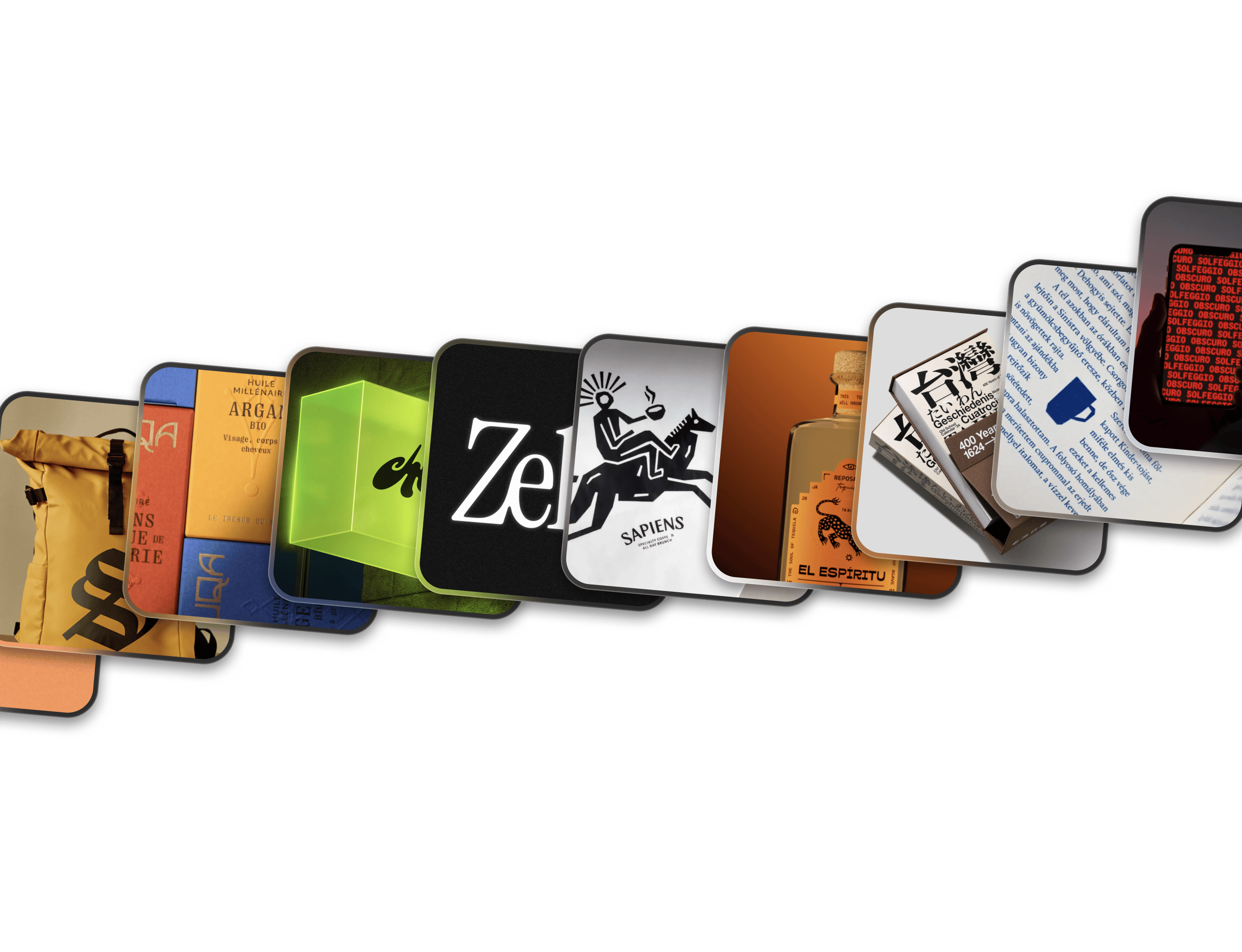
Weekly digests collect useful materials for everyone who creates digital products.
Designers
Boost their visual literacy and find materials about web design, graphic design, typography and print.
Managers
Find case studies on team management, product thinking and market analysis.
Marketers
Learn about fresh visual trends, the psychology of perception and working with neural networks to create content.
Developers
Begin to better understand the logic of interfaces, find materials about vibe‑coding and tools that speed up product development.


в месяц
в месяц
сейчас
худрук
арт-директор
дизайнеры
- Kydana Ignateva
- Misha Grin
- Albina Gainullina
- Maksim Fatfullin
